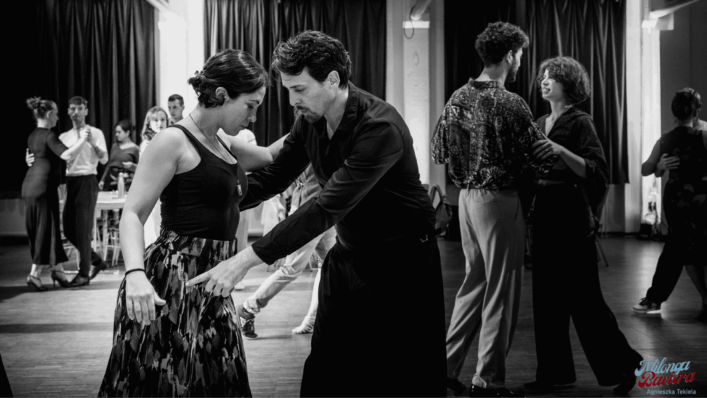
Why Social Dancers Should Learn a Choreography
For a long time, I used to think choreography was not for social dancers.
Choreography felt separate from the milonga — something staged, fixed, maybe even rigid. Social tango, on the other hand, is about improvisation, connection, and presence in the moment.
But over time, I began to see something different.
If you’ve already explored musicality — for example in Federico’s article Tango Musicality: 4-Step Beginner’s Guide — choreography is simply the next step. It makes musical structure tangible. It forces you to move from “I feel it” to “I can dance it.” And that changes your dancing.
Musical Phrasing Becomes Clear
In social dancing, we often sense the music intuitively. In choreography, we must define it.
Where does the phrase begin?
Where does it resolve?
Where do we pause — and why?
You cannot hide inside intuition alone. You listen more carefully. You count. You repeat. You refine.
The result is not mechanical dancing. It is deeper musical awareness — which later enriches your improvisation.
Repetition Is Refinement
On the social floor, we rarely repeat the same sequence twice. In choreography, we must. That repetition builds precision, and precision builds freedom.
When your body knows how to execute something reliably, you stop worrying about mechanics. You gain clarity in timing, cleaner transitions, and more confidence in delivery.
Improvisation becomes lighter — not heavier.
Responsibility in the Ronda
A choreography structured in the direction of the ronda teaches something essential: flow.
You learn to move forward with intention.
You learn to respect space.
You learn to finish what you start.
And you learn responsibility.
In the ronda, if you hesitate too long or collapse into indecision, you disturb the flow. There is always another couple behind you, wanting to move forward.
Choreography trains that awareness. Even if you make a mistake, you must continue. You cannot freeze. You cannot apologise with your body. You adapt — and move on.
That skill is pure social tango.
Structured Musicality Inspires Improvisation
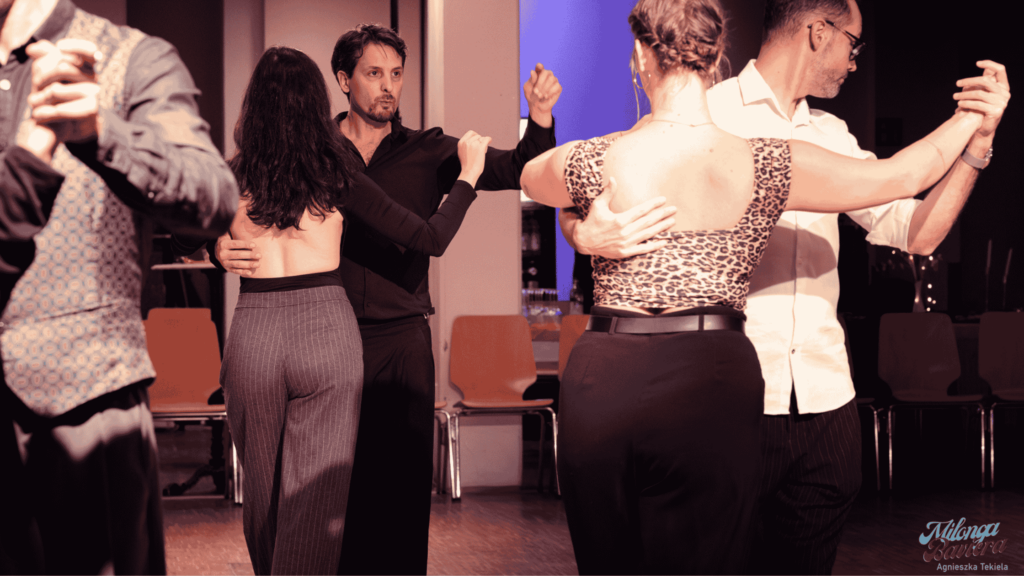
A choreography is structured musicality. It shows one possible interpretation of a piece of music — shaped, phrased, intentional.
By learning it, you internalise how to:
- build intensity,
- create contrast,
- place pauses consciously,
- complete a musical idea clearly.
Even if you never repeat the choreography socially, your body remembers its logic. And that logic appears in your improvisation.
Confidence and Stage Presence
Standing in front of others — even in a small, friendly milonga — changes something inside you.
You learn to regulate your breathing, to focus despite adrenaline, and to stay connected under pressure. Confidence does not come from comfort. It comes from doing something slightly uncomfortable — and realising you can handle it.
Many dancers say afterwards: “I feel calmer on the dance floor now.” Because once you have danced on stage, social dancing feels lighter.
If you would like to see how social dancers grow through choreography, our students will be performing at Milonga Fabulous on 13 March 2026.
Group Connection — and Practica Material
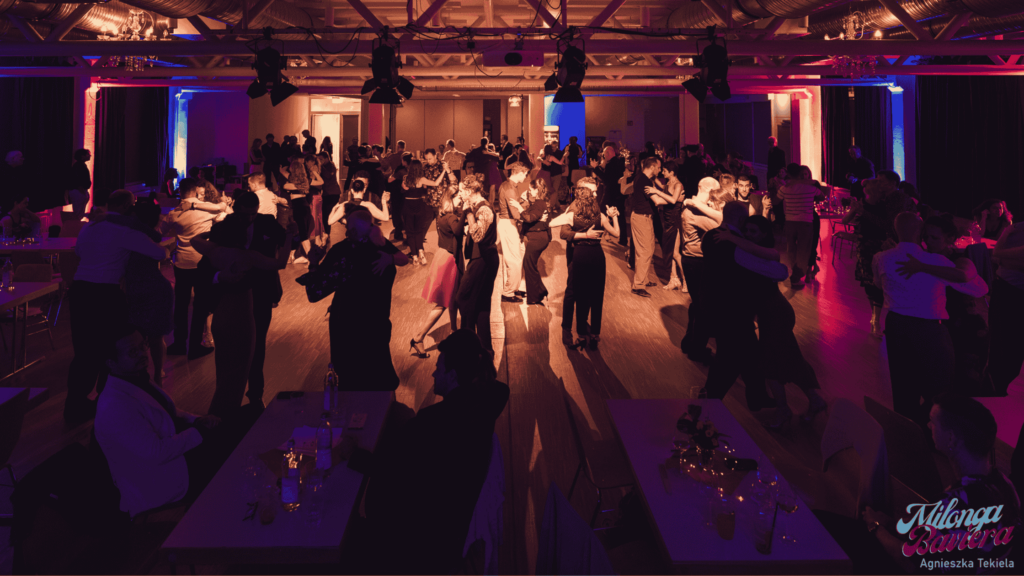
Preparing a choreography with people you see regularly in class is simply fun. You rehearse together. You adjust. You laugh. You struggle. You improve. And it gives you something incredibly practical: material for your practica.
If you’ve ever gone to a practica not knowing what to work on, a choreography becomes a perfect tool. You can repeat sections, refine details, explore dynamics, and test musical variations.
If you’d like to structure your practice more consciously, you can read:
Tango Practica – 9 Tips To Do It Like A Master! Choreography gives direction to your effort.
Not About Becoming a Performer
At Tango Flow, choreography is optional. It is not about creating professionals. It is about offering a structured growth experience for those who are curious. Social tango remains improvisational. The milonga remains central. But sometimes, stepping briefly onto a stage reveals new dimensions of your dancing. And when you return to the embrace, you carry those dimensions with you.